

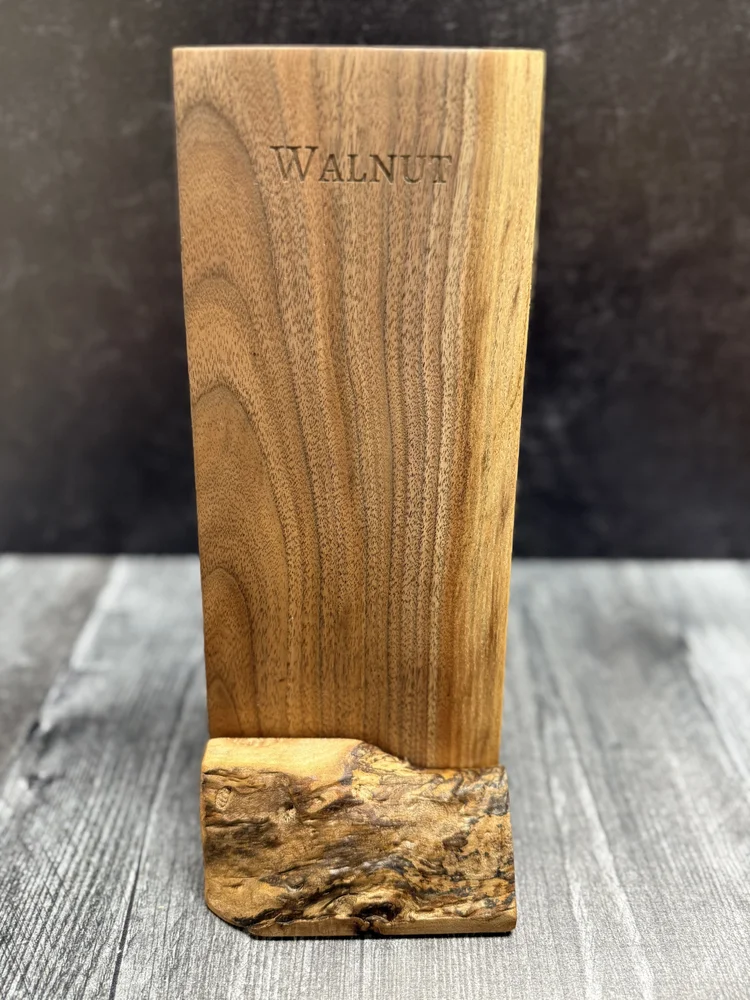
Walnut
T/R ratio of 1.4. The premier domestic furniture wood.
Juglans nigra Black Walnut · Black Walnut · Eastern and central United States
Eastern and central United States.
T/R ratio of 1. Heartwood pale brown to dark chocolate.
What you see.
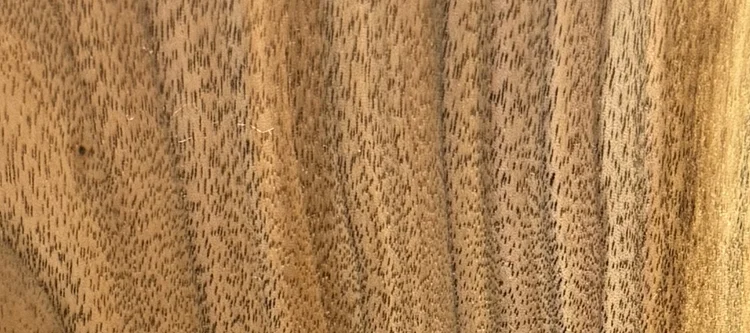
Heartwood pale brown to dark chocolate. Sometimes purple, sometimes red streaks. Sapwood is pale yellowish white, sharp contrast — though most lumber comes steamed, which pulls the color into the sap and evens it out. With time and light the heart lightens toward golden brown.
Heartwood, this specimen
How the grain runs.
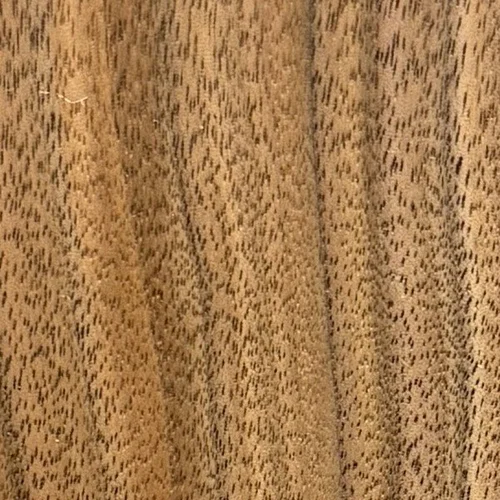
Mostly straight. Wavy and curly stock turns up near crotches and stumps — that is where the figured veneer comes from. Medium texture, good luster.
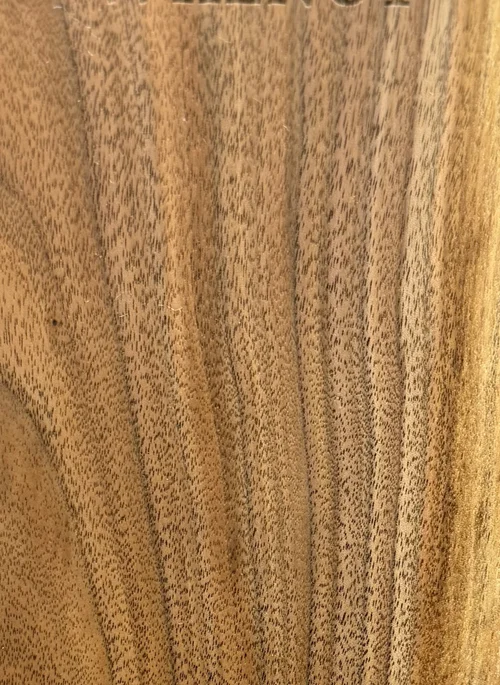
Closer in
On the bench.
Heartwood is very durable for decay. Insect resistance is moderate. Interior and protected exterior service is fine. Works clean under hand and machine. Holds dimension. Glues, stains, finishes well. Sharp tools and a measured hand on figured stock or it tears. Mild at the cut. Reported to irritate skin, eyes, and lungs. Juglone — concentrated in bark and husks, less in the wood — is the allelopathic compound, toxic to plants and to horses. Some workers react.
The numbers, looked at directly.
0lbf
4,490 N. Side-hardness — force to embed a half-inch steel ball halfway into the wood.
0lbs/ft³
610 kg/m³. At 12% MC.
0.51/ 0.55 at 12% MC
Basic over green volume; second number at 12% moisture content.
A side-hardness measurement. Higher number, harder wood.
On sourcing
Where this wood comes from matters.
Not on CITES. IUCN Least Concern. Managed across its range. Veneer logs cost what they cost; supply has tightened.
What it's for.
- Furniture
- Cabinetry
- Gunstocks
- Interior paneling
- Veneer
- Turned objects
- Instrument bodies
Worth knowing.
T/R ratio of 1.4 — radial and tangential shrinkage are unusually close. That is why walnut holds its shape better than nearly anything in its weight class. Most commercial walnut is steamed during drying. The unsteamed alternative — sometimes specified by studio makers — keeps the original two-tone contrast.
Sources & references.
- Wood Handbook — Wood as an Engineering Material (FPL-GTR-282) (2021)
- Black Walnut (Juglans nigra) — FPL Tech Sheet
- Silvics of North America: Juglans nigra L. — Black Walnut (1990)
- Juglans nigra — IUCN Red List of Threatened Species (2017)
- Juglans nigra
- Black Walnut (Juglans nigra)
- American Black Walnut — Species Guide
- The Walnut Tree: Allelopathic Effects and Tolerant Plants (Publication 430-021)