

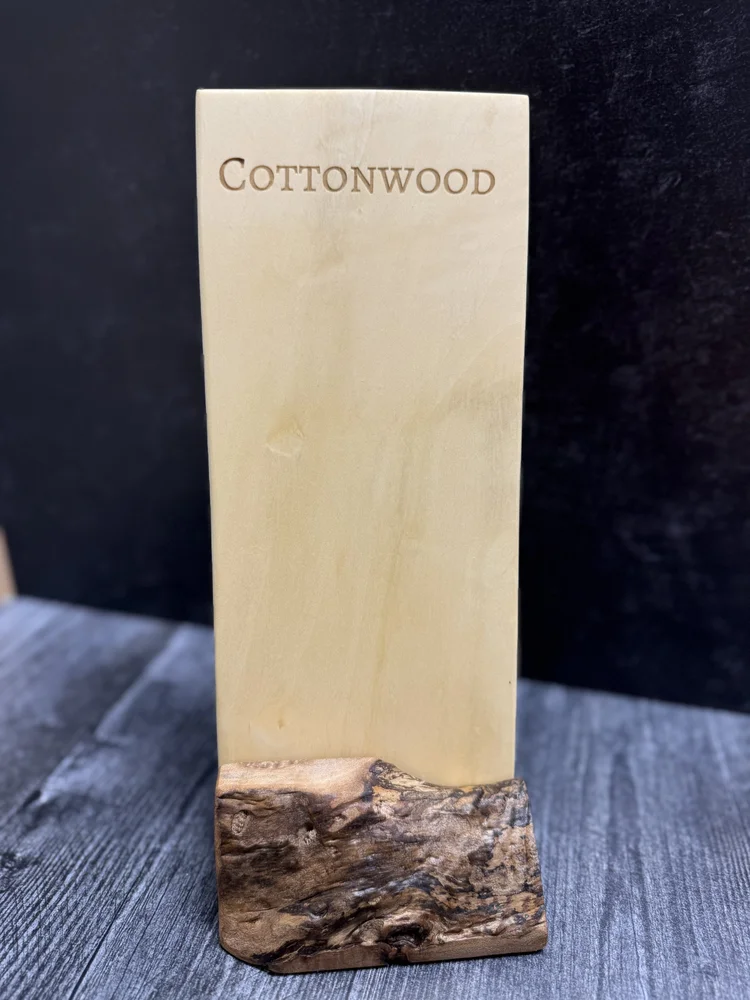
Cottonwood
The wood the cabinetmaker rarely names but often relies on.
Populus deltoides Eastern Cottonwood · Eastern Cottonwood · Throughout the eastern and central United States and southeastern Canada
Throughout the eastern and central United States and southeastern Canada.
Three to five feet of growth a year is normal. Pale grayish brown heartwood.

What you see.
Pale grayish brown heartwood. Sometimes a faint yellow or olive cast. Sapwood is creamy white and not always sharply set off. Plain. Uniform.

Heartwood, this specimen
How the grain runs.
Generally straight. Slight interlock near knots. Medium to coarse texture, low luster. Diffuse-porous, small even pores.
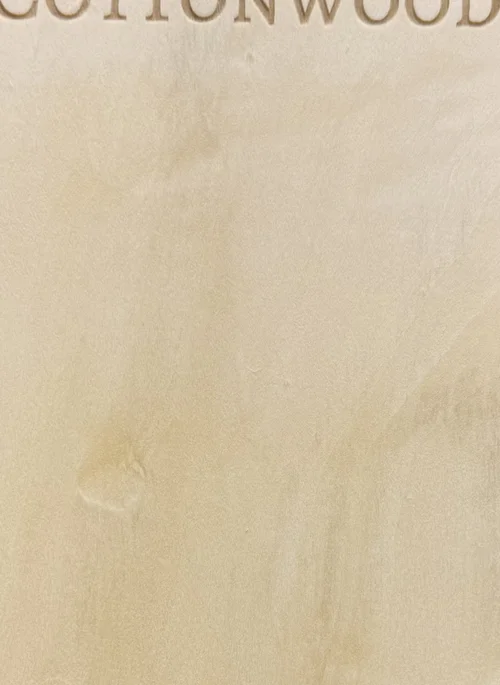
Closer in
On the bench.
Non-durable. Not for outdoor use without treatment. Machines easily but the wood is soft and fuzzes up under a dull edge. Sharp tools, careful sanding. Glues, nails, stains fine. Takes paint as well as anything. None when dry. Pollen is the famous problem. The wood itself rarely bothers anyone. Standard dust precautions.
The numbers, looked at directly.
0lbf
1,910 N. Side-hardness — force to embed a half-inch steel ball halfway into the wood.
0lbs/ft³
449 kg/m³. At 12% MC.
0.37/ 0.40 at 12% MC
Basic over green volume; second number at 12% moisture content.
A side-hardness measurement. Higher number, harder wood.
On sourcing
Where this wood comes from matters.
Not on CITES. Not on the IUCN Red List. Few hardwoods carry a lighter footprint when you cut them.
What it's for.
- Pulp & paper
- Plywood core
- Pallets & crates
- Matchsticks
- OSB
- Carving stock
- Hidden furniture parts
Worth knowing.
Three to five feet of growth a year is normal. That is why hybrid clones run plantation pulp operations worldwide. Quiet workhorse — you rarely name it but you use it. The complaint is fuzz on the sanding.
Sources & references.
- Wood Handbook — Wood as an Engineering Material (FPL-GTR-282) (2021)
- Eastern Cottonwood (Populus deltoides) — FPL Tech Sheet
- Silvics of North America: Populus deltoides Bartr. ex Marsh. — Eastern Cottonwood (1990)
- Populus deltoides — IUCN Red List of Threatened Species (2018)
- Populus deltoides
- Eastern Cottonwood (Populus deltoides)