

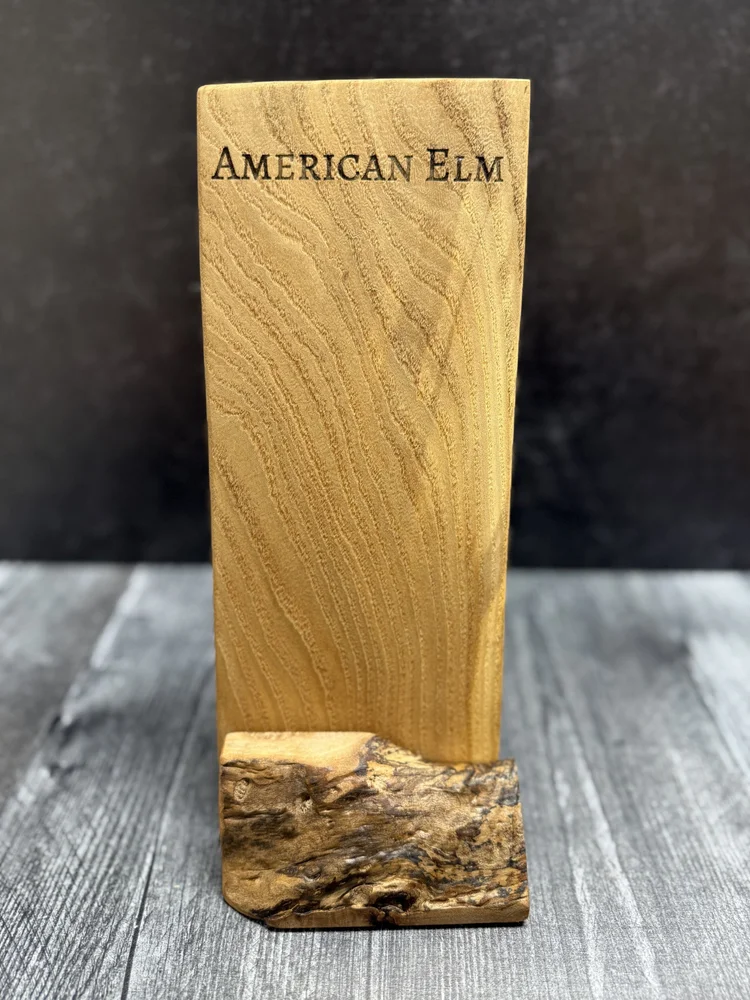
American Elm
The wheelwright's wood. The bender's wood. The street tree that left.
Ulmus americana Eastern North America from Nova Scotia west to Alberta and Montana
Eastern North America from Nova Scotia west to Alberta and Montana.
The interlocked grain is the whole story. Heartwood light to medium reddish brown.
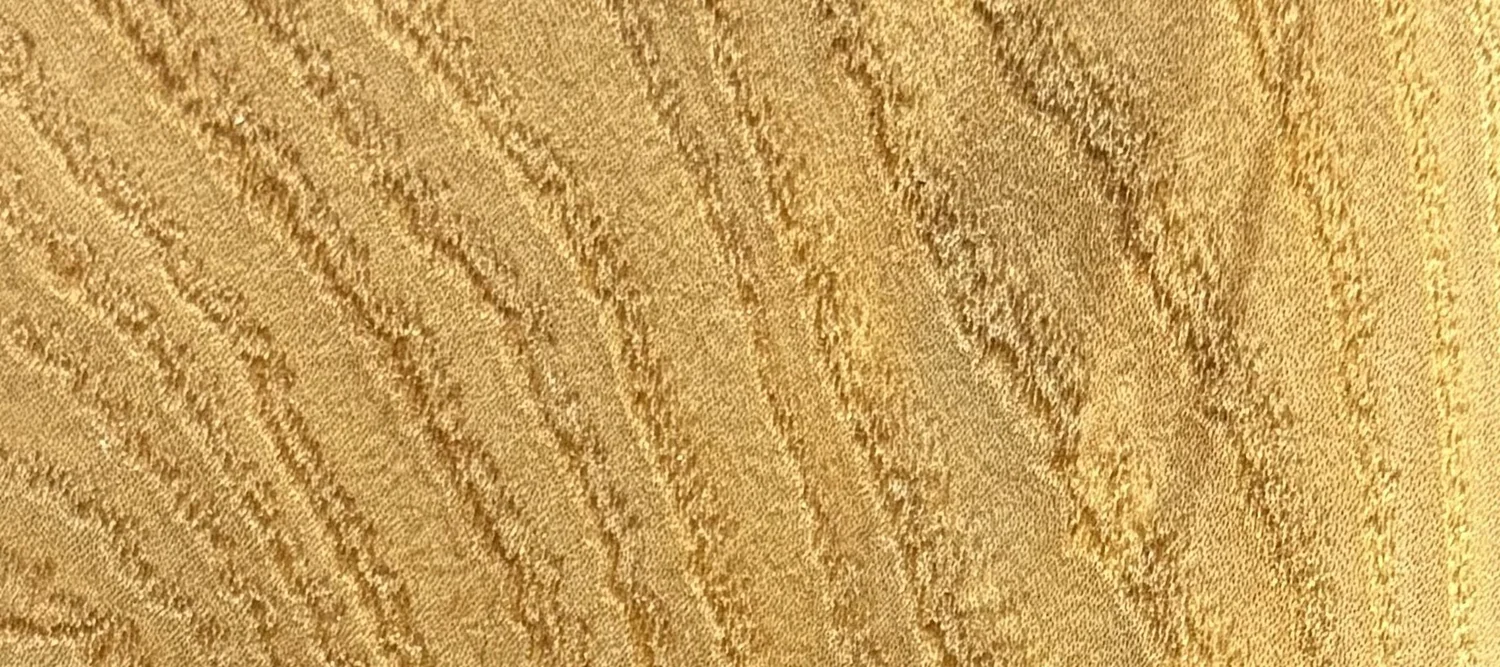
What you see.
Heartwood light to medium reddish brown. Sometimes a green or olive cast. Sapwood pale grayish white, usually well separated. Strong cathedral figure on the flatsawn face — the earlywood ring does the work.
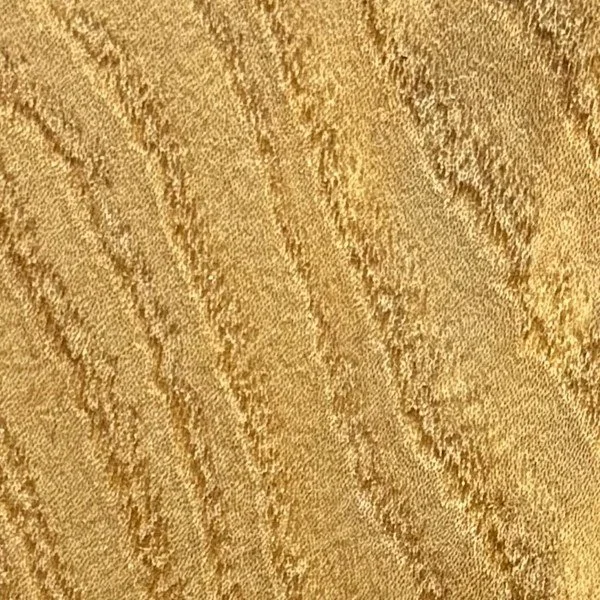
Heartwood, this specimen
How the grain runs.
Interlocked grain. That is why it splits hard and bends well. Coarse, uneven texture. Big open pores in a single ring.
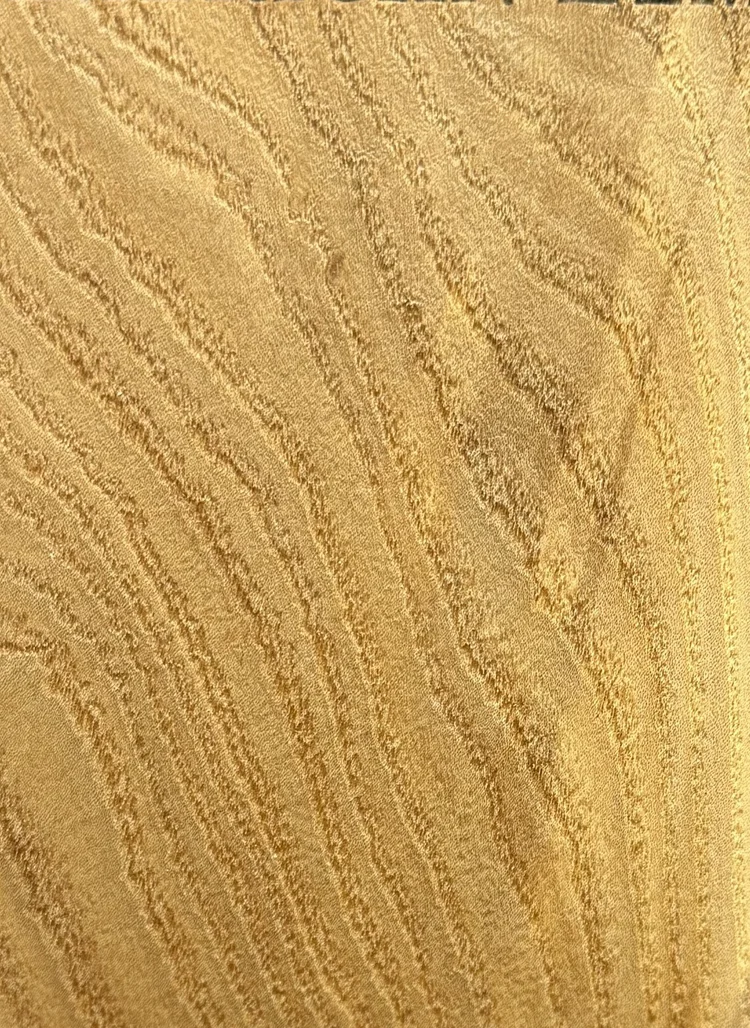
Closer in
On the bench.
Non-durable in ground contact. Bugs find it. Holds up oddly well fully submerged. Takes preservative readily. Saws and machines fine. The interlock tears on quartersawn faces — keep the irons sharp. Steam-bends as well as anything in the yard. Holds nails and screws. Stains and finishes without drama. Sour and unpleasant when green. Kiln-dried, it is gone. Reported sensitizer. Dust can irritate skin, eyes, and lungs. Most workers are fine.
The numbers, looked at directly.
0lbf
3,690 N. Side-hardness — force to embed a half-inch steel ball halfway into the wood.
0lbs/ft³
560 kg/m³. At 12% MC.
0.46/ 0.50 at 12% MC
Basic over green volume; second number at 12% moisture content.
A side-hardness measurement. Higher number, harder wood.
On sourcing
Once the great American street tree. Dutch elm disease rewrote that.
Not on CITES. Not on the IUCN Red List. Dutch elm disease ran through the population starting in the 1930s and still does. Big timber-grade trees are uncommon now. Most of what we get is urban salvage or smaller second-growth — parkway trees, mostly.
What it's for.
- Bent furniture parts
- Hockey sticks
- Tool handles
- Baskets
- Cooperage
- Veneer
- Butcher blocks
- Turned objects
Worth knowing.
The interlocked grain is the whole story. It is why elm would not split and why it bends like nothing else under steam. Disease-resistant cultivars — Princeton, Valley Forge — are getting planted again. Slow comeback.
Sources & references.
- Wood Handbook — Wood as an Engineering Material (FPL-GTR-282) (2021)
- Silvics of North America: Ulmus americana L. — American Elm (1990)
- Ulmus americana — IUCN Red List of Threatened Species (2018)
- Ulmus americana
- American Elm (Ulmus americana)
- How to Identify and Manage Dutch Elm Disease (NA-PR-07-98) (1998)
- Dutch Elm Disease — Plant Disease Lessons